Category

Apply to BCLI! Applications Open Now Through Jan. 23

Fred

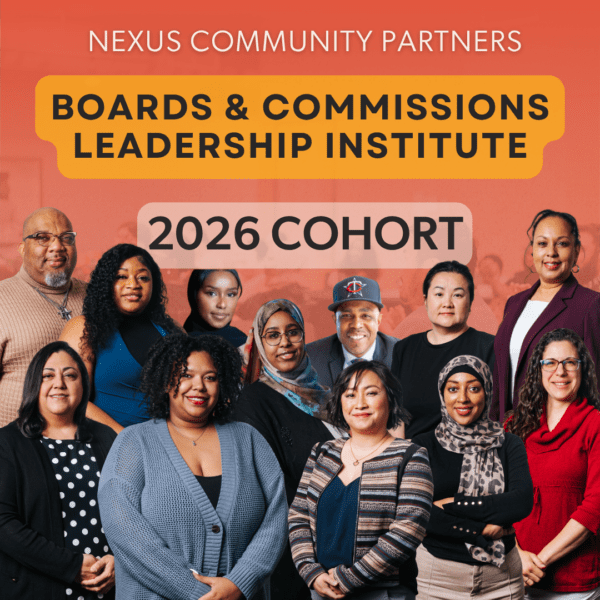
Applications for the Boards & Commissions Leadership Institute (BCLI) are open now through Friday, Jan. 23! We are excited to recruit our next cohort of equity champions who want to be effective members on boards, committees, commissions and task forces at all levels of government. Apply and learn how to get a seat on a decision-making table!

How It Works

For too long, systems of governing have rigged the rules to concentrate power and wealth in fewer and whiter hands. They’ve put up barriers to shut out Black people, Indigenous people, and people of color (BIPOC) from decision-making, as well as women, queer folks, disabled folks, low-wealth folks, and other historically marginalized and oppressed people. BCLI is a seven-month leadership program working to change this. We support, train, and help place BIPOC and other underrepresented community members on city and county publicly appointed boards and commissions.

Fellows commit to making governing decisions from the inside to nourish communities for this generation and generations to come. At a time when civic participation and democracy-building is most preciously needed, we must be engaged at every level of decision-making that affects all our communities. And that starts with boards and commissions!

Time Commitment

April – October 2026

  • Attend monthly Saturday Sessions, plus our launch event, Thursday Night Issue Series, and graduation
  • Work outside of sessions includes readings, online discussions, webinars, and commission meetings
  • Total time (including trainings and assignments) is approximately 80 hours
  • Fellows receive a small stipend of $500 to honor their time and commitment

See all dates and times

Info Sessions

Join us to learn more about the program, nomination, and selection process!

  • Tuesday, Dec. 9, 6 – 7 pm (Zoom)
  • Thursday, Jan. 8, 5:30 – 6:30 pm (In person)
Resources

By Chai Lee, Program Director, Boards & Commissions Leadership Institute

For too long, confusing rules and closed-door processes have intentionally kept power from the people most impacted—shutting out Black people, Indigenous people, and people of color from decision-making, as well as women, queer folks, disabled folks, low-wealth folks, and other historically marginalized and oppressed people. But we don’t have to stay locked out. We can cut through the confusion, claim our seats, and make governing work for us.

Boards are places where ideas can shine through and snowball into greater public policy. After all, the Minneapolis task force created to look at earned safe and sick time helped transform statewide public policy into paid family leave.

Boards can goad public opinion and change laws. Hubert H. Humphrey made a name as Minneapolis mayor by creating the first municipal civil rights boards to investigate local white supremacists for discriminatory pay and hiring practices against non-white and Jewish people. The outcome sparked the first civil rights laws at the city level. And it propelled the Humphrey name into national politics.

Board service can ignite your leadership journey. Many people use it as a springboard to launch public office bids. Once you get on a board, you encounter more opportunities to join other boards and commissions, being recognized with higher-profile roles. As an elected official and even an appointed official, you can get the political and legal privilege to sit as a member on another board or committee. For example, a member of the St. Paul City Council can sit as an ex officio member of the St. Paul Port Authority Board.

In the ongoing peace negotiations for a ceasefire in Gaza, President Donald Trump’s proposal includes a nebulous “Board of Peace,” led by himself to oversee a technocrat who will govern the future peaceful transition of Gaza. In this way, boards have control over life and death in the greatest form of state power: the exercise of legal arbitration in the field of war.

Now more than ever, BIPOC folks and others shut out of the decisions that shape our lives must get the tools we need to serve in government. This is why, through 12 cohorts and counting, our Boards & Commissions Leadership Institute trains future generations of equity warriors to serve on public bodies.

Learn more

By Chai Lee, Program Director, Boards & Commissions Leadership Institute

Boards, committees, commissions, task forces, and advisory groups guide every institution of power. They operate at all levels of government, from the neighborhood, city, regional, and county levels to the state, national, and international spheres. And in today’s volatile atmosphere of political uncertainty, it has never been more important to have a seat at the table.

What Are Boards & Commissions?

At the most basic level of community work, there may be neighborhood boards in your city that help with resident engagement, advise on development activities or city projects, and liaison with local government to alert the community about upcoming policy changes and initiatives.

  • e.g.: Minneapolis neighborhood associations and St. Paul district councils

Local government boards oversee specific municipal or county departments, such as finance, planning and zoning, education, health, or economic and workforce development. These boards are typically composed of appointed or elected officials (sometimes both) who make important decisions and policies that affect their departments.

Local government committees—like budget advisory committees, environmental committees, and human rights committees—advise governments in the decision-making process through research and policy debate. Committee members are usually picked for their lived experience, expertise on a subject matter, or their vocation.

  • e.g.: A historical preservation committee may have seats dedicated to a lawyer and a local historian.

Commissions are the most powerful forms of boards, as they have the authority to oversee and regulate specific areas (such as giving permits for land use) and even have quasi-judicial powers, resolving disputes and regulating issues under their jurisdiction. Some examples:

  • The Minnesota Pollution Control Agency is empowered by both state and federal statute to enforce laws around land use, environmental policies, and air and water pollution.
  • The National Labor Relations Board (NLRB) enforces US labor law around collective bargaining and unfair labor practices. The NLRB is governed by a five-person board and a general counsel, all of whom are appointed by the president with the consent of the senate.
  • The International Joint Commission is made up of members appointed by US and Canada governments to advise on watershed activities along the lakes and rivers that straddle the border.

Understanding the Power of Boards, Committees & Commissions

All public boards are a place where the common person can help advise government and exercise their own power and agency. Whether you represent your neighbors, peers, colleagues, or other constituent group, when you sit at the table of a board or commission, you give power to the many others behind you who may not have a voice.

  • If you sit on a planning commission, you can affect what decision the city may make with an empty parcel of land in your neighborhood. Will it become a pawn shop, a grocery store, a school, a liquor store, or a gas station?
  • If you sit on a state public health board, you can decide which public health issues and diseases may be funded for research.
  • If you sit on a county board, you can impact how direct social services are maintained, funded, and executed.
  • If you sit on an international board, you can help decide how foreign aid may be deployed in the next conflict zone or humanitarian crisis.

The Strength in Other Public Boards

In addition to traditional public bodies empowered by local government or enshrined in state and federal law, we must think of boards that are adjacent to the public sector–even if they are political. Boards are boards, even as elected bodies:

  • A school board is just a board–their members are elected and have taxing authority, which is one of the highest forms of legal power in a government.
  • A supreme court body is just a group of judges sitting as a board.
  • The legislature is simply a board of elected officials.
  • The United Nations and the European Union are formal boards, where all diplomats are appointed members who represent their legal sovereign.
  • A confederacy or federation are just fancy political-science terms for a board of different member sovereign states at a regional or international level.

Further Reading

Learn more in our next post, A Path to Power: Nexus’ Leadership Work with Boards & Commissions

As our alum Victor shared, “If you truly care about your community, if you understand that racism exists in current governing structures, and if you care about advancing equity for BIPOC and other communities who’ve been told, ‘NO, you can’t,’ then BCLI is for you.”

Applications for our next Boards & Commissions Leadership Institute cohort will open this winter. Sign up for our info session on Tuesday, Dec. 9, 6-7 pm CT, to learn all about the program!

2026 Boards and Commissions Leadership Institute Information Session: Cohort 13

Join the Boards and Commissions Leadership Institute team for an information session as we welcome applications for cohort 13! 


Tuesday, December 9

6:00 - 7:00 pm CDT

Zoom (virtual)


The Boards and Commissions Leadership Institute team will share a brief history of BCLI, discuss cohort requirements, provide a curriculum overview, and answer questions or concerns with a Q&A.


Register now to receive the Zoom invitation!


On Oct. 2, 2025, our Boards & Commissions Leadership Institute (BCLI) graduated its 12th cohort at Open Book in Minneapolis. We’re proud to welcome the 11 graduating fellows to our growing alumni network—now 168 strong!

BCLI Program Director Chai Lee opened by highlighting the program year, and Nexus Founder & CEO Repa Mekha grounded us in the need to be in community: how moving in coalitions and partnerships is more important now than ever. Repa talked about the importance of leveraging new and old connections in the BCLI network, as fellows, alumni, and trainers work to bring about more just and equitable policies in all tables where BCLI leaders may sit.

Each year, we ask a pair of graduating fellows to share their journey through the program. After welcoming remarks, BCLI Program Assistant Christine Lian introduced our 2025 speakers: Melanie Johnson and Victor Obisakin.

Melanie spoke to the power of being in community with likeminded equity champions who seek to make an impact in decision-making. She reflected on the importance of preparation and skills training provided by BCLI staff and curriculum. Victor shared that he was blown away by BCLI. When he first heard about the program, he looked up alumni and was impressed by the powerful folks who have come through in past cohorts. In his remarks, Victor noted:

“The BCLI program created a safe space where we could share our thoughts without fear of being told to shut up, be quiet, or ‘no, you can’t say that.’ In a time like today, BCLI is needed. If you truly care about your community, if you understand that racism exists in current governing structures, and if you care about advancing equity for BIPOC and other communities who’ve been told, ‘NO, you can’t,’ then BCLI is for you. If you have not joined BCLI, quit wasting your time and join.

I’ll end by quoting one of our guest speakers, Dr. Antonia Apolinario-Wilcoxson: ‘No one is coming to save you.’ So I urge you all, get ready, because you are on deck. I believe BCLI has shaped my leadership journey by equipping me with the tools to build a safer community and perhaps my state. I am more confident now than ever. I am going to run for office.”

The evening wrapped up with our keynote speaker, Robert Lilligren. Robert is the first Tribal member on the Met Council and CEO of the Native American Community Development Institute (NACDI). He is deeply committed to equity-centered regional growth. His previous work as CEO of Little Earth United Tribes and his background as a housing developer and contractor further solidify his community-development expertise. On the Met Council, Robert chairs the Community Development Committee.

Robert reflected on his long and wonderful journey in public service. He has previously served 12 years on the Minneapolis City Council. He talked about the importance of boards and committees in shaping his early life even before he realized it. As a child, he was often around Indigenous leaders who sought advice, help, and leadership from his parents. His elders were also involved in governing boards for nonprofits and in community work, so he saw firsthand how meetings were run effectively using Robert’s Rules and through the observation of his elders’ leadership.

As an adult, Robert became more engaged with his neighborhood on issues of public safety, and eventually felt a natural calling to run meetings, gather people, organize, and run for public office himself. The arc of his incredible journey was a great reminder of how early experiences on boards and commissions can build a lasting legacy of service and leadership.

We are so excited to see what comes next for our newest crop of alumni as they go out into the world and continue to move the needle on equity!

BCLI Program Director Chai Lee and Nexus CEO Repa Mekha give opening remarks.
Graduation speakers Victor Obisakin, Melanie Johnson, and Robert Lilligren.
Cohort 12 fellows take a congratulatory group photo with keynote speaker Robert Lilligren and Nexus staff: CEO Repa Mekha, BCLI Program Director Chai Lee, and BCLI Program Assistant Christine Lian.

Photos by Pa Vang

You’re invited to our Boards & Commissions Leadership Institute Cohort 12 Graduation! 🎓Come celebrate our latest leaders and hear from our program team and guest speaker at Open Book on Oct. 2, 5:30-7 pm CT.

BCLI equips those historically barred from governing to reclaim a seat at the table, joining boards and commissions to fight for equitable policies in our neighborhoods, cities, and state. Over the last seven months, our 11 fellows have been learning Robert’s Rules, municipal budgets, and other technical skills, as well as how to build coalitions and organize one-on-ones. Some of them have even already been placed on a board, committee, or commission! Our fellows are eager to lead and ready to impact the leadership landscape in Minnesota.

Robert Lilligren will be our graduation speaker this year. As the first Tribal member on the Metropolitan Council and CEO of the Native American Community Development Institute (NACDI), Robert is deeply committed to equity-centered regional growth. He is a longtime public servant who has also served on the Minneapolis City Council.

We’re excited and proud to send off another batch of bold and passionate equity champions!

RSVP here

If you want to make a change, you have to step up and see yourself as a leader. You have to lead a campaign for yourself or for others. You have to have the courage to form a team, build a coalition, and execute a vision for your community. Join the Boards & Commissions Leadership Institute (BCLI) on Thursday, Sept. 11, as we dive into the nuts and bolts of running for public office!

You’ll hear from a panel of experienced leaders who have run for or helped others run for elected office:

  • State Representative Fue Lee
  • Organizer Wintana Melekin
  • St. Paul School Board Member (and BCLI Alum) Erica Valliant

Stepping Up to Serve: Running for Elected Office

Join the Boards and Commissions Leadership Institute (BCLI) at its next public learning event, The Issue Series! 


Thursday, September 11

6:00 - 7:00 pm CDT

Zoom (virtual)


How can you affect policies that touch all aspects of the daily life of you, your friends, family and neighbors? From changing policies on land use to helping to direct funds for public health, elected officials at all levels of government determine so many policies that affect us all. 


Please RSVP and join us as we hear from a panel of experienced leaders who have run for or helped others run for elected office. 


Register now to receive the Zoom invitation!


In an era of rising authoritarianism, staying grounded, informed, and resilient is not just necessary—it is survival, and it is revolution.

How do we think clearly and act effectively if we are not in the business of radical self-care while navigating these unprecedented times of stress, uncertainty, and oppression? How do we organize and lead in a way in which we are calm, our communities are safe, and we can all remain powerful in these times? When a regime’s entire strategy is to overwhelm us, how do we see and work through the noise to keep democracy alive?

Guest presenter Noel Nix joined our Boards & Commissions Leadership Institute to share how we can take care of ourselves while continuing to fight to maintain our republic and the spirit of equality. Watch the recording below!


About Noel Nix

Originally from Michigan, Noel has spent most of his life in Minnesota, where he’s developed a deep appreciation for both the vibrancy and challenges in our community. After seeing and experiencing the struggles faced by those working in community over the course of his career with the City of Saint Paul and Ramsey County, Noel embarked on a new journey in mental health to extend compassionate care to individuals and couples seeking healing and growth.

Noel’s approach to counseling is rooted in person-centered, multicultural, feminist, and radical healing perspectives. As a Black, heterosexual, cisgender man, he is dedicated to creating a safe, inclusive space where clients can explore thoughts and emotions without judgment or bias. While Noel supports individuals of all professional backgrounds, he is particularly interested in supporting people working in government, education, first response, health care, community organizing, social work, and other community-based work.

He holds a Bachelor of Science in Business and a Master of Urban and Regional Planning from the University of Minnesota, and a Master of Counseling Psychology from the University of St. Thomas.

In an era of rising authoritarianism, staying grounded, informed, and resilient is not just necessary—it is survival, and it is revolution.

How do we think clearly and act effectively if we are not in the business of radical self-care while navigating these unprecedented times of stress, uncertainty, and oppression? How do we organize and lead in a way in which we are calm, our communities are safe, and we can all remain powerful in these times? When a regime’s entire strategy is to overwhelm us, how do we see and work through the noise to keep democracy alive?

Join our Boards & Commissions Leadership Institute and guest presenter Noel Nix on Aug. 14 to learn how we continue to fight to maintain our republic and the spirit of equality.

Self-Care, Resistance and Resilience: Defense Against The Political Dark Arts

Join the Boards and Commissions Leadership Institute (BCLI) at its next public learning event, The Issue Series! 


Thursday, August 14

6:00 - 7:00 pm CDT

Zoom (virtual)


We live in extremely uncertain times, with new federal directives attacking our rights at every turn, literally every day. How can we thrive in these uncertain political times?


Register now to receive the Zoom invitation!


About Noel Nix

Originally from Michigan, Noel has spent most of his life in Minnesota, where he’s developed a deep appreciation for both the vibrancy and challenges in our community. After seeing and experiencing the struggles faced by those working in community over the course of his career with the City of Saint Paul and Ramsey County, Noel embarked on a new journey in mental health to extend compassionate care to individuals and couples seeking healing and growth.

Noel’s approach to counseling is rooted in person-centered, multicultural, feminist, and radical healing perspectives. As a Black, heterosexual, cisgender man, he is dedicated to creating a safe, inclusive space where clients can explore thoughts and emotions without judgment or bias. While Noel supports individuals of all professional backgrounds, he is particularly interested in supporting people working in government, education, first response, health care, community organizing, social work, and other community-based work.

He holds a Bachelor of Science in Business and a Master of Urban and Regional Planning from the University of Minnesota, and a Master of Counseling Psychology from the University of St. Thomas.

On a sunny spring morning, we gathered with Nexus friends old and new to celebrate the power of our Boards & Commissions Leadership Institute (BCLI), kicking off the first in a series of online learning events for our 20th anniversary.

When we established the Boards & Commissions Leadership Institute 12 years ago, there was nothing like it in our region. Local transit organizers in the community were tired of just being consulted; they wanted to have a seat at the decision-making tables. BCLI was our answer.

Nexus Founder and CEO Repa Mekha shared, “We understood that who plans, who governs, who owns, and who stewards resources has always been at the crux of sustained inequities in this country. We’ve known that from the beginning. And so we pushed. 10-plus years later and 157 alumni strong, we have the foundation now of a growing movement of equity-minded leaders with a shared analysis and common tools across the state. That’s the power we have in being with each other.”

During the two-hour event, we had the honor of hearing from guest speakers Peggy Flanagan, Lieutenant Governor of Minnesota; Victoria McWane-Creek, Founder of Organization 4 Full Participation; and Hodan Hassan, former Minnesota State Representative.

As they shared their reflections, advice, and encouragement, some common themes emerged:

“Our maximum performance calls for maximum care.”

Repa Mekha, Nexus Founder & CEO

“We are stronger together than apart,” Repa said. “We all have something to contribute, a part to play, no matter how large or small. This work is about movement building. And it has to have as many faces, facets, and angles as possible. It takes all of us. The equity work that we do in small places is connected to a cause much larger than the spaces we operate in, much larger than our individual contributions. And as we do the work of champions, we need the tools, knowledge, skills, and wisdom for change. But we also must take care of ourselves.”

“Self-care is a must,” Hodan continued. “This is heavy work and it’s emotional labor. Always root yourself in the why—why are you doing this work? If you center around the why, the work gets more joyous and more beautiful.”

“Whatever space that you envision yourself to be in, that’s where you belong.”

Hodan Hassan, 2016-17 BCLI Alum

Lt. Governor Flanagan emphasized, “We’re supposed to be at these tables. We are meant to be at these tables. We must be at these tables. And having support to do that is incredibly powerful.”

Keep Easing Down the Road

Victoria shared the inspiration she draws from her grandmother and The Whiz song “Ease on Down the Road.”

‘Cause there may be times when you think you lost your mind
(And the steps you’re takin’ leave you three, four steps behind)
But the road you’re walking might be long sometimes
You just keep on steppin’ and you’ll be just fine

Lt. Governor Flanagan said, “If you are feeling down in this time of great uncertainty, where for many of us, simply our existence is being challenged … I also want you to just feel hopeful. Take a step back and look at all of the work that these 157 people have been able to do. We are powerful in this moment. We are powerful at these tables. We are powerful when we take up space and we speak to our own lived experience.”

Hodan advised, “Reach within. Show up for one another. Connect with your community. Continue grounding in the work. Surround yourself with the right people and continue the work. Tomorrow is a different day.”

Repa reminded us: “The most inspiring and landscape-shifting change that we’ve seen for decades and decades has grown out of chaos. We found strength and possibility and we rose every time. And guess what? We will rise again. There is no going back. There is no letting go. There is no stumbling. We can see the future that we want to create.”

Join us in giving a warm welcome to our 2025 BCLI Cohort! For the next seven months, these 11 changemakers will be equipped to serve on city, county, metro, and state boards and commissions, walking alongside one another in power-building and leadership. Together, they are working to advance equity across economic development, health, housing, transit, and workforce development in Minnesota.

Our new fellows join a network of 157 alumni. Over half of them have been appointed to a board or commission or hold a high-level policy position, and all of them are building racial and economic equity in their communities.

Learn more about each fellow here!

A lot has changed since our founding in 2004. Through it all, our communities have remained strong because of our collective care, ingenuity, and unrelenting drive for transformative change. To celebrate 20 years of working together, we’re hosting five events throughout 2025. At each gathering, we will look back to look ahead, and envision a brighter, more powerful future for us all.

We’re starting off with our longest-running program: The Boards & Commissions Leadership Institute (BCLI)! Mark your calendar for our virtual event, Building Power through Bold Leadership, on March 27, 10 am – 12 pm CT on Zoom.

Fill out the form below or follow this link to register!

For 12 years, BCLI has been helping community leaders build the skills and networks they need to create big policy change, from city-wide paid sick time to fighting housing discrimination. With fascism on the rise, this work is more important than ever. We must continue to work together to identify, train, and support leaders who are reflective of and responsive to our communities. Together, we are powerful!

Hear from guest speakers on the scope and impact of BCLI. You’ll learn how this program will continue to shape how decisions are made throughout Minnesota—and walk away with the tools and relationships we need to navigate these times.

Featuring:

  • Hodan Hassan, former State Representative for MN Senate District 62B, and BCLI alumna
  • Peggy Flanagan, Lieutenant Governor of Minnesota
  • Victoria McWane-Creek, Consultant/founder of Organization 4 Full Participation, BCLI alumna, and current North Star fellow

All are welcome! This isn’t just for Twin Cities folks; BCLI is building bridges across Minnesota. Mark your calendar and join us—we can’t wait to see you there!

Nexus Community Partners Event Registration

Sorry, this form is not available.